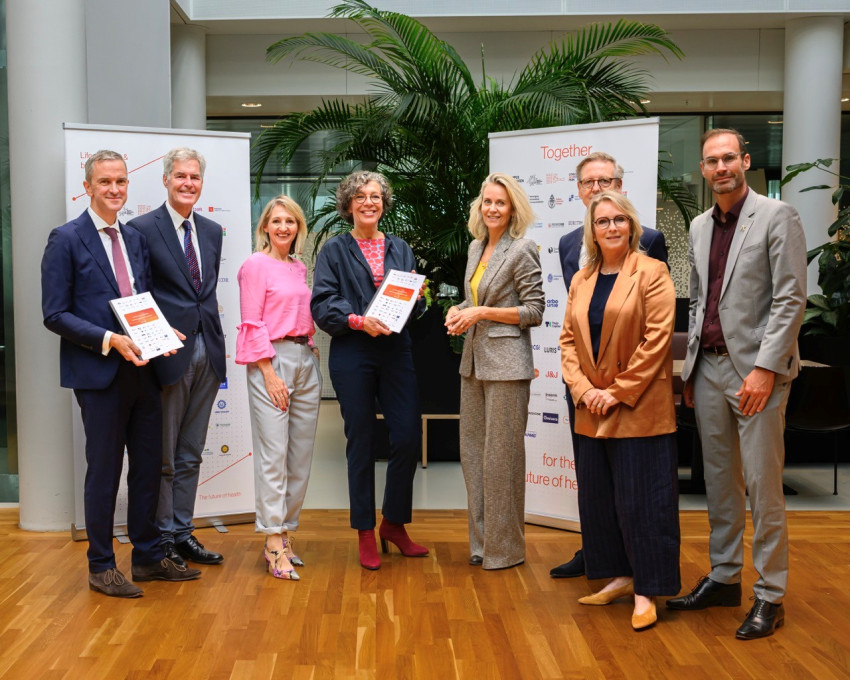
Red biotechnology offers the Netherlands a chance to combine economic growth with societal progress. The Red Biotech Plan, developed by Leiden Bio Science Park together with the sector and other Dutch clusters, sets out how the Netherlands can make better use of that opportunity.
The Netherlands has strong knowledge institutions, specialised companies and a good starting position in red biotechnology. Yet that position cannot be taken for granted. Scientific knowledge does not automatically lead to new products, successful companies and manufacturing on Dutch soil. That takes targeted investment, collaboration and the right conditions.
That is why one question sits at the heart of the Red Biotech Plan: how can the Netherlands turn its knowledge and expertise more effectively into economic and societal value?
From science to economic value
Red biotechnology covers the development of novel medicines, vaccines, diagnostics and advanced therapies. It is a sector in which scientific progress can contribute directly to people’s health, while also creating economic opportunity.
Developing and manufacturing medicines requires specialised facilities, highly skilled expertise and collaboration between research institutions, start-ups and established companies. The result is a value chain that relies not only on researchers and biotech companies, but also on manufacturers, investors, technical specialists and business service providers.
If the Netherlands succeeds in strengthening this chain further, more economic activity stays in the country. Companies can scale, new businesses emerge, and investments deliver greater returns for the Dutch economy. At the same time, the Netherlands can contribute to the development of new treatments and to the availability of medicines worldwide.
This is about more than the growth of a single sector. Red biotech can contribute to broad prosperity: economic development that goes hand in hand with better health, high-quality jobs and a stronger position for the Netherlands in a world where access to essential medicines matters more and more.
The opportunities are already here
The Red Biotech Plan builds on the knowledge, infrastructure and businesses the Netherlands already has. The ambition is to accelerate the development of new medical applications, give companies more room to scale up, and strengthen the production of medicines and other biotechnological products in the Netherlands.
The potential economic gains are considerable. According to the economic analysis in the plan, strategic choices and targeted investment could deliver a structural annual contribution of 1.2 per cent to gross domestic product and 21,000 additional jobs over the period 2026 to 2035. These are projections, and they depend on how the proposed approach is implemented.
The Leiden region plays an important role here. Leiden Bio Science Park is the largest life sciences & health cluster in the Netherlands, where research, medical expertise, start-ups and international companies actively come together. That concentration of knowledge and enterprise makes the park a key link in the Dutch biotech ecosystem. But the opportunities reach beyond the region. A stronger sector strengthens the Dutch economy as a whole and can help reduce dependence on foreign production of critical medicines.
From ambition to delivery
A strong scientific base alone is not enough to seize these opportunities. Companies need access to funding and suitable facilities, new technologies need room to grow, and procedures need to keep pace with the speed at which the sector moves. It also requires collaboration between companies, knowledge institutions, investors and government.
That is why the Red Biotech Plan proposes developing Biotech Nexus: a national programme that brings the sector’s strengths together and helps improve the conditions for growth and scale-up, as one integrated approach. The aim is to connect promising initiatives more effectively and make better use of investment.
The next step calls for urgency. International competition is not standing still, and other countries are investing in their biotech sectors too. Within Europe alone, Belgium and Switzerland invest three to six times as much in medical biotech, with a correspondingly larger share of GDP. The Netherlands does not have to start from scratch, but it does need to make sure existing knowledge and strong initiatives have enough room to develop.
For Leiden Bio Science Park, the task is clear: to help build an ecosystem in which scientific knowledge can grow into economic activity and societal progress. The opportunities are there. By investing in a targeted way and getting the conditions right, red biotech can become a major driver of the Netherlands’ future prosperity, health and resilience.